• Skip to primary navigation
  • Skip to main content
  • Skip to primary sidebar
  • Home
  • About
  • Contact
  • Privacy + Terms
  • Affiliates

The Chaos and the Clutter

  • Facebook
  • Twitter
  • Pinterest
  • Google Plus
  • RSS
  • Email
  • School at Home
  • Sensory
    • Sensory Processing Disorder
    • Awesome Sensory Play Activities
      • Sensory Bins
      • Sensory Bottles
      • Sensory Bags
  • Family Games
    • Minute to Win It Games
  • Special Needs Parenting
    • Childhood Anxiety
    • Reactive Attachment Disorder
    • Sensory Processing Disorder
  • Store
  • Course Login

Sensory

Navigating the Store with a Child with Sensory or Anxiety Issues

By Sharla Kostelyk

When you’re the parent of a child with sensory or anxiety issues, a simple trip to the grocery store can be daunting. With so many of my kids having special needs, I’ve certainly had to endure my share of public meltdowns. Now I go into those situations armed with the right tools to help my kiddos cope. Grocery shopping is manageable again.

Grocery Shopping Survival Tips for children with sensory or anxiety issuesThe most important thing I’ve learned is to better understand my child. If I believe that my child is just trying to be difficult, I am going to go into the situation with frustration as my foundation. If I believe that the situation is one that is extremely difficult for my child, I go in with compassion as my foundation. 

As I’m sure you can imagine, me coming from a place of compassion is going to go over very differently than me coming from a place of frustration.

This video simulation shows what a trip to the store would be like for someone experiencing sensory overload.

For children with Sensory Processing Disorder, a typical grocery store is a veritable nightmare of sounds, lights, colours, temperature changes, and smells. These can lead to challenging behaviours.

For children with anxiety, any public place can trigger fears. There is so much that is unknown even if it’s a location they have visited many times because the people who will be there are an unknown variable. Anything could potentially happen.

If there is nothing else you take with you from reading this, please take this with you. Understanding why your child is reacting to the triggers they face when they go to the store (or another public place) is crucial to being compassionate in your reactions to their behaviours and being sensitive to their feelings.

Other tips for navigating the store with a child with sensory or anxiety issues:

  • Optimize your chances of success by ensuring your child is well rested and well fed.
  • Have your child use the bathroom before you leave home. If you forget this step, you’ll want to read these tips for surviving a public washroom with a child with sensory issues.
  • Give as much warning as possible. Tell them also how many stops or stores will occur on the outing.
  • Let them know what to expect. When going to a new store, I have even shown my child pictures (either ones I have taken or ones I find online) to help them prepare. Give them as much information as you can. My kids like to see my grocery list ahead of time so they know about how long it will take us.
  • Discuss potential or known triggers and have a plan for coping with them. Encourage your child to talk to you if they begin to feel overwhelmed. Sometimes meltdowns occur before they can pinpoint the source of the trigger but other times, communication can avert a potential meltdown.
  • If it’s a new store, take a short trip there first to buy one item. Build your child’s trust by really just buying that one item even if you remember other things you need while there. I know this is not easy to do but building that trust with your child is so important.
  • Use sensory solutions such as noise cancelling headphones, fidgets, sensory balls, and tight fitting clothing or weighted vests to help your child cope.
  • Give your child something to hold in their pocket such as a sensory ball or fidget. This will serve two purposes. It will help calm them and it will keep their hands in their pockets instead of touching everything in sight.
  • Acknowledge and praise any success. Celebrate the baby steps and don’t make a big issue out of setbacks. There will be setbacks, but it is possible to go out in public with a child with sensory or anxiety issues without it being a disaster.
  • And if there is a meltdown, be sure to be compassionate towards your child instead of being distracted by the potential judgment of others.

Join me for a free 5 part email series, Little Hearts, Big Worries offering resources and hope for parents.

This post is part of a Parenting a Child with Special Needs series with special needs moms who share their thoughts on “managing public situations.” These articles may help you navigate your way through your next time out in public.

How I’ve Learned to Manage Public Situations as a Special Needs Parent | My Home Truths

10 Tips for Running Errands with a Special Needs Child | Every Star is Different

7 Tips to Surviving Judgment as the Parent of a Special Needs Child | The Chaos and The Clutter

Navigating the Store with a Child with Sensory or Anxiety Issues | The Chaos and The Clutter

Dear Mom at the Park | This Outnumbered Mama

Dear Mom Who Is Afraid to Leave Her House | Kori at Home

How to Help a Mom When Her Child Suffers a Public Meltdown | Finding the Golden Gleam
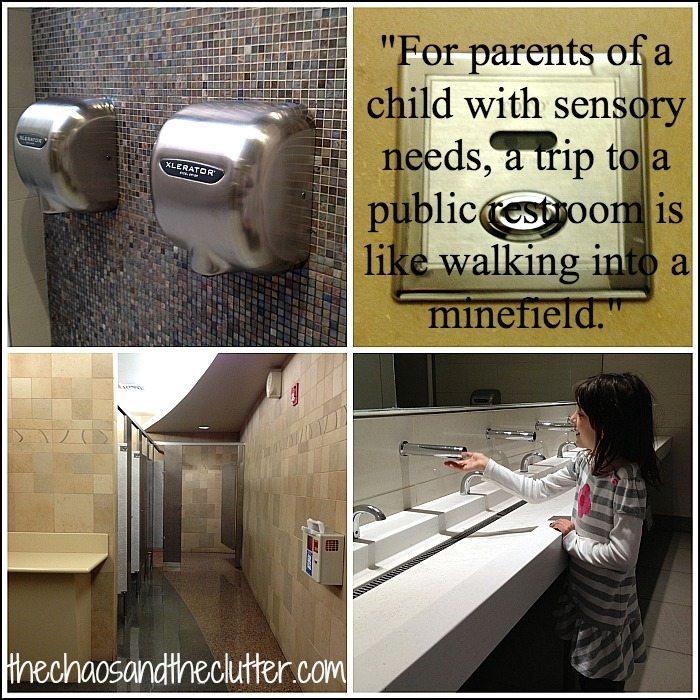
public bathroom tips for children with sensory issuesSurviving Public Bathrooms with a Child who has Sensory Needs

Filed Under: Sensory, Special Needs Parenting

7 Tips to Surviving Judgment as the Parent of a Child with Special Needs

By Sharla Kostelyk

It’s a Tuesday morning and you head to the grocery store. You’ve specifically chosen a Tuesday morning because it’s the least busy at this particular store. You have your list organized according to the layout of the store. You spend half an hour preparing your child for what to expect on the outing. You drive there armed with fidgets and stress balls with calming music playing softly in the background. You even let them wear the superhero costume without saying a word because you know it helps them both feel braver and feel more regulated because it fits tightly.

7 tips you need to survive the judgment from others when you are parenting a child with special needsYou have done everything you can think of to ensure this grocery trip is as pain-free as possible. You park. Take a deep breath. Turn around, smile at your child and together you walk in.

You get through the produce section with all its smells and unexpected mini sprinklers without issue. You mentally congratulate yourself for remembering to prepare your child for those potential pitfalls this morning!

You get through most of the aisles without anything dramatic happening. Even the cereal aisle is navigated without distress. You’re starting to breathe a bit easier now. You can see the end in sight.

You swing by the pharmacy where the kind pharmacist is very familiar with your family. Your child knows them well enough to respond and say hello. You can see that this has raised their anxiety just a bit and as you walk away from that counter, you check in with your child to see how they are managing. You tell them that you appreciate how well they are doing. You encourage them by showing them how much of the grocery list is complete.

In the dairy section, you see signs that the tension is mounting. There’s a temperature change and the lights are bright. It’s starting to get a bit more crowded in the store by now. Your child is touching everything you pass by and has knocked an item off the shelf.

You hand your child the list and a pencil and ask them to cross off what’s been found so far. You know that in doing so, you will give them a visual and tangible reminder of how close they are to being done. You will also give them something to do with their hands.

Your child comments that the wheel on the cart is squeaky. You are reading the back of a box trying to determine if it’s gluten free so you don’t respond right away. You move on towards the checkout but your child is standing back where you were, hands over their ears, screaming. You judge the distance between yourself and them and know that you will not make it in time to stop this from becoming a huge meltdown.

As you rush towards them, you mentally play back the trip to the store. Playing detective is an important part of your job as the parent of a child with special needs. You decide based on the evidence that it’s the squeaky wheels on the cart that were the final straw so you abandon your cart mid aisle and rush faster towards your child to help them calm down.

Out of the corner of your eye, you catch glares, a man shaking his head disapprovingly and a woman is approaching you, bent on sharing her “wisdom”. You know what’s likely coming. Not “good job mama”. Not “can I help?”

Judgment.

You’re well acquainted with the whispers, the glares and the outright rude comments. Years ago, you may have left the store in tears over her ignorant words, but not today. Today you know that her words are more a reflection of who she is than who you or your child are. Today, your only worry is your child. You’ve got this!

Tips to Surviving Judgment as the Parent of a Child with Special Needs:

  1. Breathe.
  2. Choose and practise a mantra that you can say internally. “They cannot steal my joy.” “I am the right mom for my child.” “They do not have the privilege of knowing my child.” “This is them, not me.”
  3. Know that you do not need to respond. It is not your job to educate the world at the moment your child needs you most.
  4. Better they judge you than your child. Often, it is tempting to explain your reasons, your methods, your child’s needs to save face. Sometimes it is appropriate to do so, but if your response is only going to further isolate your child and make them feel more different, you may need to risk being judged.
  5. Surround yourself with those who “get it”. Create a network of support people who understand. Those who have also walked this road are safe to share with. They can offer encouragement in a way that no one else can. If there is not a support group in your community, find one online.
  6. Keep track of your wins. Parenting a child with special needs can be discouraging at times because it’s often two steps forward, one and three quarters steps back. Celebrating your wins will help you rise above the judgment because you will have confidence that your child is moving in the right direction.
  7. Remember that you know your child best and that your child is doing their best. “They’re not giving you a hard time. They’re having a hard time.”

Join me for a free 5 part email series, Little Hearts, Big Worries offering resources and hope for parents.

This post is part of a Parenting a Child with Special Needs series with special needs moms who share their thoughts on “managing public situations.” These articles may help you navigate your way through your next time out in public.

How I’ve Learned to Manage Public Situations as a Special Needs Parent | My Home Truths

10 Tips for Running Errands with a Special Needs Child | Every Star is Different

7 Tips to Surviving Judgment as the Parent of a Special Needs Child | The Chaos and The Clutter

Navigating the Store with a Child with Sensory or Anxiety Issues | The Chaos and The Clutter

Dear Mom at the Park | This Outnumbered Mama

Dear Mom Who Is Afraid to Leave Her House | Kori at Home

How to Help a Mom When Her Child Suffers a Public MeltdownI Finding the Golden Gleam

Filed Under: Adoption, Sensory, Special Needs Parenting

What Does Behaviour Have to do with Sensory Systems?

How is behaviour affected by your child's sensory systems?

By Sharla Kostelyk

Have you ever wondered, “What does my child’s behaviour have to do with their sensory systems?” I’ve been there, feeling like pulling my hair out because of these seemingly strange behaviours my child has. My introduction into the world of Sensory Processing Disorder (though at the time it was called Sensory Integration Disorder) came thanks to our oldest daughter, Miss Optimism.

How is behaviour affected by your child's sensory systems?Miss Optimism was what people referred to as a busy child, always moving and often getting into mischief. She would spin around and around and around and never seemed to get dizzy. She would strip off her clothes in winter to put on a bathing suit just as we were about to walk out to door to get groceries. When we finally did get out the door to go shopping, she would reach out and touch everything on the shelves and even sometimes touch people as we walked past.
She had a freakishly high pain tolerance and it would sometimes lead to injury as she also seemed to have no concept of danger. She broke things by accident because she wasn’t aware of her own strength. One of the many things she broke was the necklace I had worn at my wedding.

She would have meltdowns for what seemed to be no reason. She pulled down all the decorations in her room and started to pick holes in her walls.

She was the pickiest eater I had ever met. She didn’t seem to have any attention span and would flit from one activity to another, leaving a huge mess behind her everywhere she went.

She preferred to be upside down to being right side up. And upside down is how I was starting to feel my life was while I tried to figure out how to parent her!

It wasn’t until I got a phone call from her preschool teacher asking me what her diagnosis was that I realized that these things were not typical behaviour for a child her age. That began my entry into the world of Sensory Processing Disorder. We began working with an OT. In using her suggestions and adjusting things in our home, the changes in our daughter were significant and immediate.

The more I learned about sensory, the more I was able to recognize that her challenging behaviours were actually sensory responses. I could then give her strategies to help her cope. And in making changes in her environment, she was able to find moments of calm and learn how to better express her needs.

One of the first steps in making adjustments in your home and in your expectations is to better understand what behaviours are related to sensory needs. It is important to also understand which sensory system those needs relate to.

If you understand which sensory system is at play, you can implement sensory solutions specific to that sensory system in order to target it and reduce “behaviours”.

I find that it is helpful to think of behaviours that result from sensory needs as side effects instead of purposeful behaviours. They are simply a side effect of our child getting too much or too little of the “medicine” (sensory input of that sensory system).

When we determine what our child is getting too little or too much of, we can adjust the dosage accordingly.

These are just a sample of examples to help you determine your child’s sensory needs. Each sensory system has other “side effects” as well but these should give you a good idea of what to look for.

As you can see from this list and the behaviours I described in my daughter, it is possible and in fact probable that a child can show seeking behaviours for some things and avoidance behaviours for others.

You will also see that some behaviours like chewing on clothing can be representative of more than one sensory system, so you will have to do some detective work to discover which system is at play and how to meet those sensory needs.

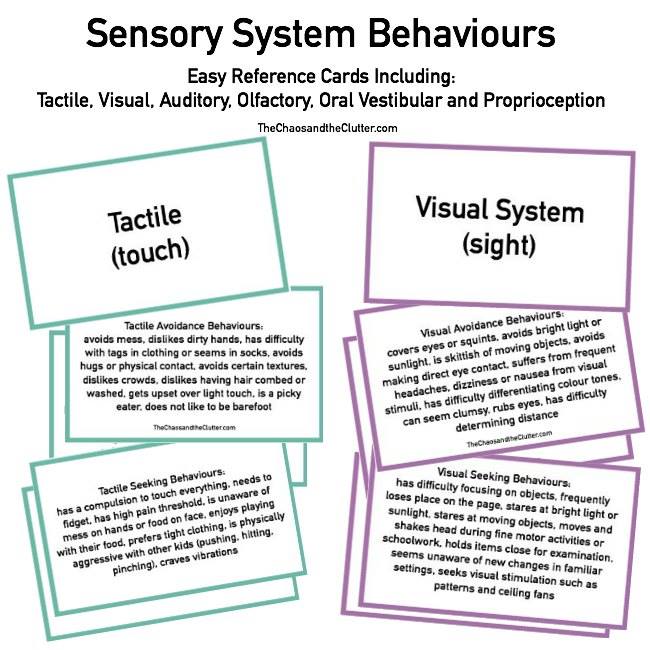
To get your free Sensory System Behaviours Easy Reference Cards and be included in a 5 part email series Sensory Solutions and Activities, simply sign up here.

Tactile Avoidance Behaviours:

  • avoids mess
  • dislikes dirty hands
  • has difficulty with tags in clothing or seams in socks
  • avoids hugs or physical contact
  • avoids certain textures
  • dislikes crowds
  • dislikes having hair combed or washed
  • gets upset over light touch
  • is a picky eater
  • does not like to be barefoot

Tactile Seeking Behaviours:

  • has a compulsion to touch everything
  • needs to fidget
  • has a high pain threshold
  • is unaware of mess on hands or food on face
  • enjoys playing with their food
  • prefers tight fitting clothing
  • is physically aggressive with other kids (pushing, hitting, pinching)
  • craves vibration

Visual Avoidance Behaviours:

  • covers eyes or squints
  • avoids bright lights or sunlight
  • is skittish of moving objects
  • avoids making direct eye contact
  • suffers from frequent headaches
  • gets dizziness or nausea from visual stimuli
  • has difficulty differentiating colour tones
  • can seem clumsy
  • rubs eyes
  • has difficulty determining distance

Visual Seeking Behaviours:

  • has difficulty focusing on objects
  • frequently loses place on the page
  • stares at bright light or sunlight
  • stares at moving objects
  • moves and shakes head during fine motor activities or schoolwork
  • holds items closely for examination
  • seems unaware of new changes in familiar settings
  • seeks visual stimulation such as patterns and ceiling fans

Auditory Avoidance Behaviours:

  • is distracted by background noise
  • gets upset by sudden noise
  • becomes angry or emotional because of loud noise
  • covers ears
  • dislikes common noises such as toilet flushing or vacuum cleaner running
  • gets upset by high pitched noises

Auditory Seeking Behaviours:

  • creates loud noises
  • uses their “outdoor” voice indoors
  • screams
  • listens to loud music
  • leans closer to noise
  • is calmed by white noise such as a fan or a sound machine
  • makes noises out of household objects like tapping a pencil on the table

Olfactory Avoidance Behaviours:

  • gags at certain foods or smells
  • avoids specific smells
  • becomes visibly upset by strong smells
  • comments on the smell of people or places
  • avoids people or situations because of scent

Olfactory Seeking Behaviours:

  • feels the need to smell things
  • prefers foods and objects with strong smells
  • does not differentiate between “safe” smells and “dangerous” smells
  • smells people and animals
  • explores the world through scent

Oral Avoidance Behaviours:

  • avoids brushing teeth
  • avoids certain food textures
  • gags, chokes or drools
  • avoids trying new foods
  • has difficulty using a straw
  • has problems chewing or swallowing

Oral Seeking Behaviours:

  • likes chewing or sucking on items such as pencils and clothing
  • likes spicy food
  • likes very hot or very cold food
  • chews nails
  • has a clear preference for certain foods
  • might enjoy licking non-food items
  • might have a problem overstuffing their mouth

Vestibular Avoidance Behaviours:

  • may seem clumsy or uncoordinated
  • may appear stubborn
  • has a dislike of movement activities
  • might be fearful of elevators
  • does not like stairs or clings to the railing
  • has a fear of being upside down
  • might have dislike of playground equipment

Vestibular Seeking Behaviours:

  • has a hard time sitting still
  • is constantly in motion (fidgeting, spinning, rocking, moving)
  • goes “full force” in movement activities or sports
  • might be impulsive
  • runs rather than walks
  • takes risks that can potentially lead to injury
  • hangs off the couch or chair
  • likes to be upside down

Proprioception Avoidance Behaviours:

  • avoids active activities such as running, jumping and climbing
  • can be a picky eater
  • avoids touch
  • desire to do familiar activities
  • can have difficulty using stairs
  • can seem uncoordinated
  • can appear lazy and lethargic

Proprioception Seeking Behaviours:

  • unknowingly uses too much force
  • stomps or walks loudly
  • difficulty with body awareness
  • bumps into objects, walls or people
  • kicks, bites, hits, or pushes
  • prefers tight fitting clothing
  • chews on objects such as pencils or clothing
  • gets into others’ personal space
  • excessively physically affectionate
  • does not realize own strength and may mistakenly break things

Filed Under: Sensory, Special Needs Parenting

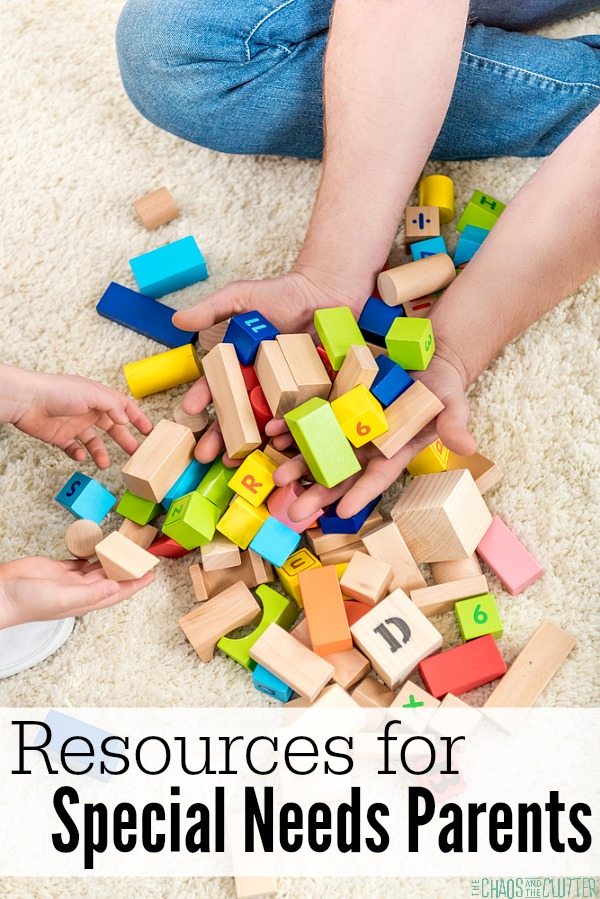
Special Needs Parenting Resources

By Sharla Kostelyk

As the mom of five kiddos with Special Needs, I am always looking for helpful information and suggestions. Over the years, I have come across some articles that have made this hard road just a tiny bit easier or a bit less lonely and for that, I am grateful. These special needs resources are designed to provide you with information and encouragement. I’ve specifically included resources for developmental delays, sensory needs, early childhood trauma, autism, anxiety, meltdowns, general special needs, and encouragement.

I’ve compiled some special needs parenting resources that I hope will be as helpful for you as they have been for me.


Special Needs Parenting Resources:

Create Your Own Anti-Anxiety Kit for Your Child from here on The Chaos and The Clutter

More Calm in the Chaos Printable Planner for Moms of Special Needs Kids from here on The Chaos and The Clutter

Resources & Encouragement for Parents of Children with Autism from Growing Hands on Kids

Advice for Parents of Kids with Special Needs from here on The Chaos and The Clutter

Helping a Child Through Trauma from here on The Chaos and The Clutter

Practical Speech Therapy Activities for Practise at Home from Mommy Speech Therapy

Our Favourite Books for Kids About Special Needs from here on The Chaos and The Clutter

Autism Resources from A-Z for Acceptance and Understanding from This Outnumbered Mama

Resources to Teach Kids About Emotions (and How to Handle Them) from here on The Chaos and The Clutter

The Ultimate Guide to Brain Breaks (SO helpful!)

The Ultimate Guide to Occupational Therapy Resources for Kids from Growing Hands On Kids


ADHD in kids: The Ultimate Survival Guide for Overwhelmed Parents
from Parents with Confidence

Tips and Tales from a Reformed Anti-Labeller from here on The Chaos and The Clutter

7 Sanity Saving Tips if you Suspect Your Child has Special Needs from B-Inspired Mom

12 Myths About Recognizing Developmental Delays from Life Over C’s

Recognizing the Signs of Reactive Attachment Disorder from here on The Chaos and The Clutter

Warning Signs of Early Childhood Development Problems from 3 Dinosaurs

Understanding the Impact of Childhood Trauma from STEAM Powered Family

Making the Choice to Medicate Your Child from here on The Chaos and The Clutter

The Busy Mom’s Guide to Juggling Multiple Appointments from here on The Chaos and The Clutter

20 Strategies to try while Waiting for an Autism Diagnosis from And Next Comes L

Sensory Resources:

Does my Child have Sensory Processing Disorder? from here on The Chaos and The Clutter

Sensory Meltdowns: Causes, Prevention and Strategies from here on The Chaos and The Clutter

Is it Behaviour or Sensory? a series from Growing Hands On Kids

What to Do with Kids Who Chew from here on The Chaos and The Clutter

Tight Fitting Clothing: A Sensory Mystery Unravelled from here on The Chaos and The Clutter

Sensory Processing 101 from Sensory Processing 101

Sleep Solutions for Kids with Sensory Needs from here on The Chaos and The Clutter

175 Sensory Activity Ideas from here on The Chaos and The Clutter

Parenting the Heart of Your Sensory Child from My Mundane and Miraculous Life

Must-Haves for Kids with Sensory Needs from here on The Chaos and The Clutter

Sensory Hacks to Calm an Angry Child from Lemon Lime Adventures

6 Tips to Survive a Public Bathroom with a Child with Sensory Needs from here on The Chaos and The Clutter

What’s the Point of Sensory Bins, Bottles and Bags? from here on The Chaos and The Clutter

Meltdowns:

Calming the Fight, Flight or Freeze Response from here on The Chaos and The Clutter

Calm Down Breathing for Kids from here on The Chaos and The Clutter

13 Effective Calm Down Activities for Kids from here on The Chaos and The Clutter

Is my Child having a Sensory Meltdown? from here on The Chaos and The Clutter

Special Needs Mom Encouragement:

Why Special Needs Moms are Exhausted All the Time from Life Over C’s

Special Needs Mama: You are Amazing from here on The Chaos and The Clutter

Encouraging Bible Verses for Special Needs Moms from This Outnumbered Mama

Dear Special Needs Mom (Encouragement from Everyone Else) at Raising the Extraordinary

An Open Letter to the Mom of a Special Needs Child on Encouraging Moms at Home

Support from Others:

4 Simple Ways You Can Support Special Needs Parents from B-Inspired Mama

12 Things That Special Needs Mom Needs from You from here on The Chaos and The Clutter

Supporting Yourself and Your Child with Special Needs from Natural Beach Living

Supporting a Family with High Medical Needs from Grace and Green Pastures

Supporting a Family Whose Child is in the Hospital from here on The Chaos and The Clutter

To Grandparents of Special Needs Children from Every Star is Different

Join me for a free 5 part email series, Little Hearts, Big Worries offering resources and hope for parents.

Filed Under: Sensory, Special Needs Parenting

Unique Slime Recipes

By Sharla Kostelyk

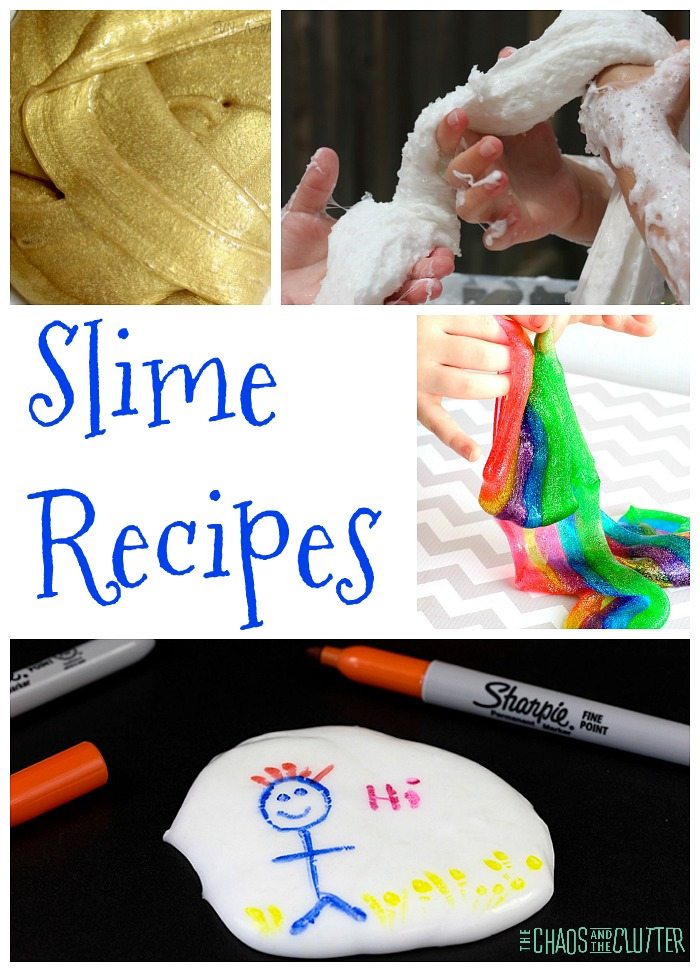
Slimes are a great sensory activity for kids. There are many slime recipes out there. I wanted to showcase some of the most unique slime recipes. I’m sure you will find these as cool as your kids will find them!

These unique slime recipes are sure to wow! From magnetic slime to colour changing slime to slimes made with the most unusual ingredients you can imagineMy kids, in particular my girls, are always on the lookout for cool slime recipes. Our kitchen now has so many plastic containers and resealable bags full of different types of slime!
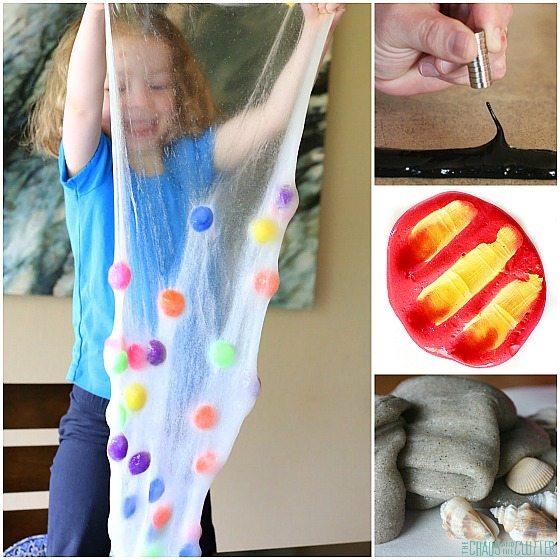
My girls scour the internet and Pinterest searching for the latest and greatest slime ideas, which is one of the reasons that I decided to put this list together and have all the types of slime in one place.

Unique Types Of Slime

Unique Slime Ingredients

Edible Fluffy Slime

This taste safe slime uses all edible ingredients. It is borax free and has no contact lens solution, so it’s completely safe for toddlers and little ones who might still be putting things in their mouths.

Textured Butter Slime

This very unique slime actually uses old playdough that’s started to dry up as one of its ingredients. So not only does it have an awesome buttery texture, it also makes use of something you might otherwise have just thrown away.

Diaper Slime

This recipe from Sugar, Spice and Glitter has got to be one of the most unique slime ideas out there. It gets its fluffiness from the crystals in disposable diapers!

Cornstarch Slime

STEAM Powered Kids has tested out 3 different cornstarch slime recipes and provides detailed instructions as well as revealing which one is their favourite of the bunch.

Super Stretchy No Borax Slime

What makes this type of slime from STEAM Powered Kids so different is that it doesn’t use Borax, liquid starch or detergent.

Sand Slime

This slime idea by Little Bins for Little Hands uses real sand to create a fun sensory slime.

Unicorn Slime

Our unicorn slime contains both shaving cream and foaming hand wash as well as other ingredients, giving it a unique consistency.

Crunchy Slime

The add-ins in our Frozen Inspired Elsa Slime make it crunchy. This texture contrasts the squishiness of the slime making it a truly unique experience.

Halloween Slime

Spider Web Slime

There’s a “secret” slime ingredient in this one that makes it look like a spider web.

Hallowe’en Slime

I love the look of this glittery slime. It’s simple, but still very cool.

Rainbow or Glitter Slime

Glow in the Dark Slime

Anything glow in the dark is just plain fun, and then add glitter!

Rainbow Slime

I love the contrast of colours in this simple rainbow slime recipe with a twist. It’s one we really like.

Rainbow Glitter Slime

This glittery rainbow slime from MomDot is perfect for St. Patrick’s Day or Spring.

Science Slime

Magnetic Slime Recipe

This magnetic slime recipe (yes, really!) from Frugal Fun for Boys and Girls is part sensory, part science and all fun!

Heat Sensitive Colour Changing Slime

Another science lesson with slime can be found in this colour changing slime by Left Brain Craft Brain.

Galaxy Slime

This gorgeous galaxy slime from Two Daloo is super cool!

Slime With Clear Glue

Polka Dot Slime

Fun at Home with Kids’ polka dot slime is the first slime recipe I ever tried to make and it turned out wonderfully. The key is to use the clear glue.

Stretchy Christmas Tree Slime

This slime is extremely stretchy. That makes it fun to play with. Like all slimes, it’s also pretty fun to make.

Fall Leaves Slime

This simple recipe is a great way to welcome autumn and bring some colour and texture to sensory play.

Minnie Mouse Slime

I’m a huge Minnie Mouse fan, so this Minnie Mouse slime was kind of an inevitability! It turned out to be super cute.

Edible Slime

Baby Safe Edible Slime

Wildflower Ramblings came up with this safe slime recipe that even little ones can play with.

Slime Drawing

Slime Drawings

Who would have ever thought to use slime for artwork?! I love this idea from Left Brain Craft Brain.

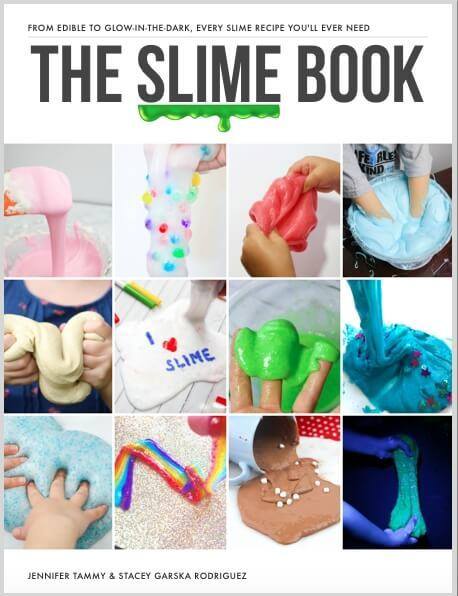
For more awesome slime recipes at your fingertips, check out The Slime Book –

From Edible to Glow-in-the-Dark Slime – it’s got it all!

Easy Gold Slime – I’m amazed at the way this slime from Fun a Day sparkles.

Chocolate Slime – Even though this chocolate slime invented by Little Bins for Little Hands is not edible, I’ll bet it smells delicious!

Glow in the Dark Slime – Playdough to Plato created this slime recipe that glows in the dark.

Mud Slime – This ooey-gooey slime from Frugal Fun for Boys and Girls is like elevating a mud pie.

The only question now is what cool slime recipe are you going to try first?!


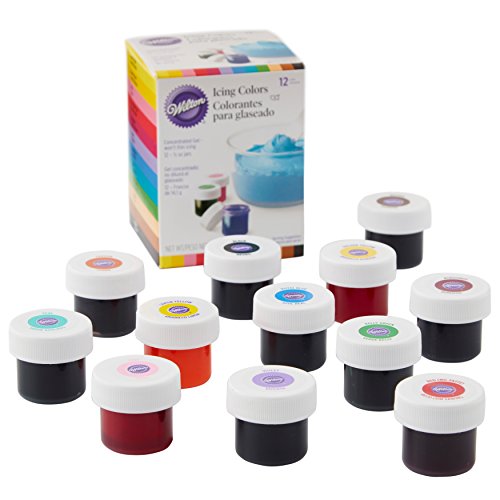
Common slime ingredients:

Elmer's White School GlueElmer’s White School GlueElmer's White School GlueSaline SolutionSaline SolutionSaline SolutionWilton ColorsWilton ColorsWilton ColorsFine GlitterFine GlitterFine Glitter

Join me for a free 5 part email series Sensory Solutions and Activities (just pop your email into the box below) and get a free sample of our Sensory Play Recipes eBook.

If you are looking for other slime ideas, you can find our list of the Cool Slime Recipes here.

Filed Under: Sensory Tagged With: sensory play

Squishy Sky Sensory Bag

By Sharla Kostelyk

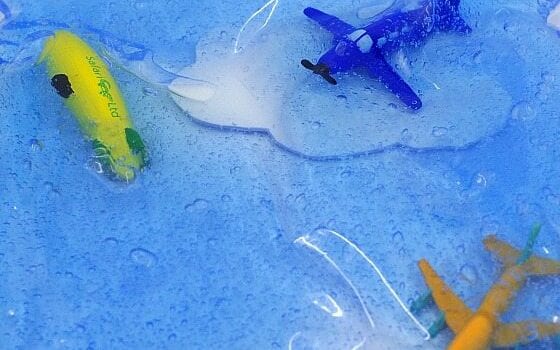
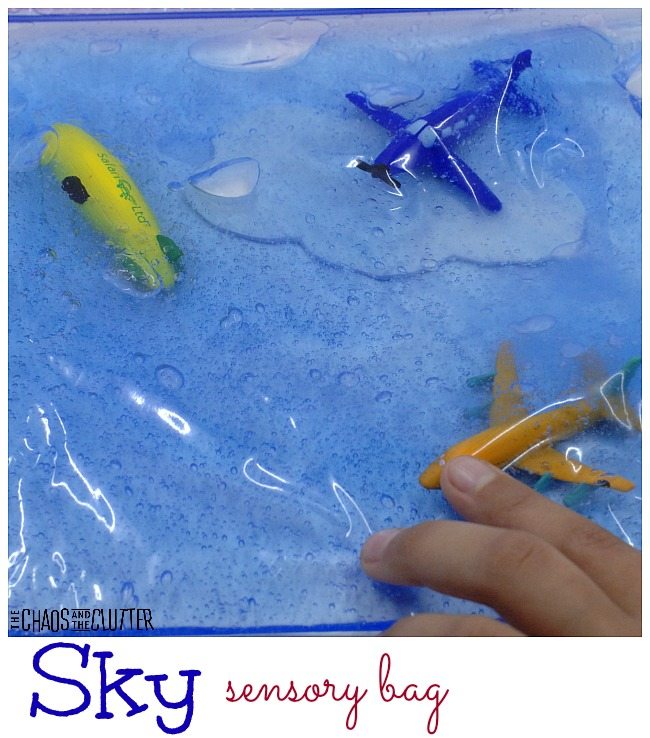
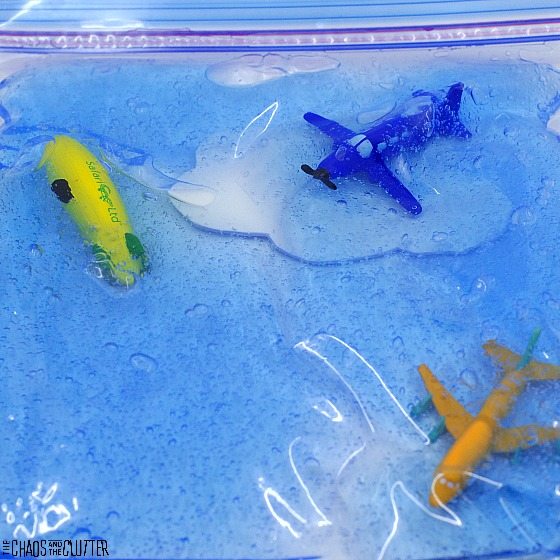
This squishy sky sensory bag is simple to make and you only need a few materials. Depending on the age of your child, they can even help cut out the clouds to make the sensory bag.

Sky sensory bag is perfect for little explorers.Materials needed:

  • medium sized resealable freezer bag
  • blue hair gel or blue body wash
  • white foam sheet
  • In the Sky toob
  • scissors

Using scissors, cut some cloud shapes out of the white foam sheet. If you are having your child help you with this step, you can lightly sketch the outline of a cloud with pencil and have them cut along the outline.

Place the foam clouds inside a resealable bag. Add a few items from the In the Sky toob and squeeze some blue hair gel or body wash into the bag. Remove excess air from the bag and seal.

I prefer to use a good quality freezer bag rather than a sandwich bag for sensory bags because they are more durable and I prefer the size as well.

If you’re using these sky sensory bags with younger children, you can secure the opening of the bag by folding strong clear packing tape or duct tape over the top of the bag. You can also do this to all sides of the bag for extra durability.

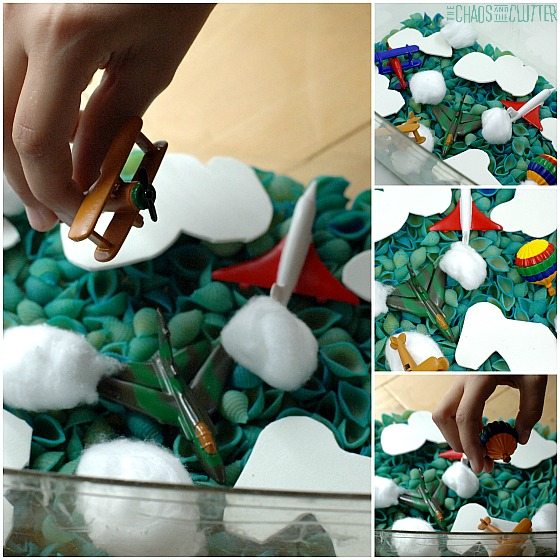
I used the same In the Sky toob to make a Sky Sensory Bottle and a Sky Sensory Bin. All of these were perfect during our Flight Unit in homeschooling.
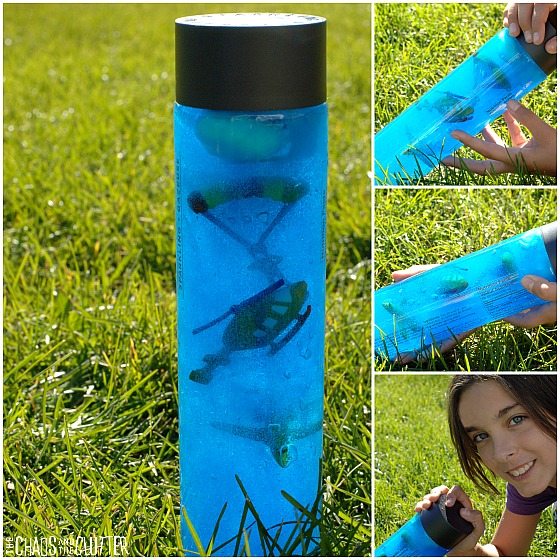
Sky Sensory Bottle

Sky Sensory Bin

Join our free 5 part email series Sensory Solutions and Activities and get our Sensory System Behaviours Easy Reference Cards.

Filed Under: Sensory Tagged With: sensory bags, sensory play

  • « Go to Previous Page
  • Page 1
  • Interim pages omitted …
  • Page 31
  • Page 32
  • Page 33
  • Page 34
  • Page 35
  • Interim pages omitted …
  • Page 50
  • Go to Next Page »

Primary Sidebar

Categories

We are a participant in the Amazon Services LLC Associates Program, an affiliate advertising program designed to provide a means for us to earn fees by linking to Amazon.com and affiliated sites.

Copyright © 2026 • The Chaos and the Clutter • Site Design by Jeni @ The Blog Maven

Return to top of page

Copyright © 2026 · Chaos and the Clutter 2.0 on Genesis Framework · WordPress · Log in